By Emma Richardson — Senior WordPress Automation & Digital Business Systems Specialist
Technical Review by Michael Carter — Senior WooCommerce Developer & eCommerce Solutions Specialist
SEO Review by Sarah Mitchell — Senior SEO Strategist & WordPress Content Optimization Specialist
Introduction
Product review websites remain one of the most practical ways to build an affiliate-driven online business. People search for reviews, comparisons, alternatives, tutorials, and buying guides before they make purchasing decisions. That behavior creates a clear opportunity for website owners who can help users choose the right products with honest, useful, and well-structured content.
However, creating a product review website is not simply about publishing reviews or adding affiliate links to blog posts. A serious review website needs a structured product database, helpful content workflows, strong SEO, clear review standards, and reliable systems for keeping information updated.
This is where artificial intelligence and WooCommerce work well together.
AI can help speed up product research, content planning, outline creation, comparison tables, first drafts, FAQs, and content refreshes. WooCommerce gives you a structured way to manage products, categories, affiliate links, product pages, and review-related content.
Used correctly, this combination helps you build more than a review blog. It helps you build a scalable product review business system.
In this guide, you will learn how to create a product review website with AI and WooCommerce, including niche selection, WooCommerce setup, product database planning, AI-assisted content creation, SEO, automation, monetization, and long-term growth strategy.
Why AI and WooCommerce Are a Powerful Combination
Many website owners think of WooCommerce only as a tool for selling products directly. That is one use case, but WooCommerce can also work as a powerful product management system for affiliate and review websites.
Once your review website grows beyond a small number of products, managing everything inside individual blog posts becomes difficult. Affiliate links change. Pricing changes. Product screenshots become outdated. New alternatives appear. Comparison tables need updates. Without a structured system, maintaining accuracy becomes time-consuming.
WooCommerce solves this by giving you a centralized product catalog. Instead of treating every product mention as a disconnected piece of content, you can organize products into a structured database that supports reviews, comparisons, buying guides, and affiliate recommendations.
WooCommerce can help you manage:
- Product names and descriptions
- Product categories and tags
- Affiliate URLs
- Product images and screenshots
- Pricing information
- Product features
- Related reviews and comparisons
AI then improves the workflow around that structure. It can help you research products faster, organize review outlines, generate draft sections, summarize feature differences, identify comparison opportunities, and refresh older content.
The important point is that AI should support your workflow, not replace your judgment. A strong review website still needs human editing, fact-checking, product validation, and experience-based recommendations.
Benefits of Building a Product Review Website with AI and WooCommerce
The biggest advantage of using AI and WooCommerce together is not speed alone. The real advantage is building a repeatable system.
A review website becomes much easier to grow when products, content, links, and updates are organized around a clear workflow.
Centralized Product Management
Imagine managing 150 affiliate products across dozens of reviews and comparison articles. If every product detail is stored manually inside blog posts, updating information becomes frustrating. WooCommerce gives you a central place to organize product data, making your review website easier to maintain as it grows.
Faster Content Production
AI can help reduce the time required for research, outline creation, first drafts, comparison structures, FAQs, and content refreshes. This allows you to produce content more efficiently while still applying human review and editorial control.
Better Internal Linking
Because WooCommerce organizes products into categories, collections, and product pages, it becomes easier to connect reviews, tutorials, buying guides, and comparisons. This supports both user experience and topical authority.
Easier Product Comparisons
Comparison content is one of the strongest content types for review websites. A structured product database makes it easier to compare features, pricing, use cases, pros, cons, and alternatives across multiple products.
Long-Term Scalability
A small review website can survive with manual workflows. A larger review website cannot. Once you move from 20 products to 200 products, systems matter. WooCommerce gives your product information structure, while AI helps you create and update content more efficiently.
Choosing a Profitable Product Review Niche
Niche selection is one of the most important decisions you will make. A good niche gives you enough search demand, affiliate opportunities, and content depth to build a long-term business. A weak niche limits your growth before you even start.
The best product review niches usually share five qualities.
Commercial Intent
People should actively spend money in the niche. Review websites work best when users are already comparing paid products, tools, services, or subscriptions.
Search Demand
Users should be searching for reviews, comparisons, alternatives, tutorials, and buying guides. Without search demand, even strong content may struggle to attract traffic.
Affiliate Opportunities
The niche should include multiple affiliate programs or partner opportunities. Relying on one program creates risk.
Content Depth
A strong niche should support many articles, not just a few reviews. Look for opportunities to create tutorials, comparisons, alternatives, product roundups, FAQs, and use-case guides.
Long-Term Viability
The niche should continue evolving. Products should receive updates, new competitors should enter the market, and users should continue searching for guidance.
Examples of Strong Product Review Niches
| Niche | Affiliate Potential | Content Opportunities |
|---|---|---|
| WordPress Plugins | High | Reviews, comparisons, tutorials, alternatives |
| WooCommerce Extensions | High | Plugin reviews, buying guides, workflow tutorials |
| SEO Tools | High | Comparisons, case studies, feature breakdowns |
| Web Hosting | High | Reviews, speed tests, alternatives, comparisons |
| AI Software | High | Reviews, workflows, tool comparisons, tutorials |
| Email Marketing Platforms | High | Automation guides, comparisons, use-case reviews |
For GPLStage’s audience, WordPress, WooCommerce, SEO, hosting, AI software, automation tools, and marketing platforms are especially strong because they combine affiliate potential with educational content opportunities.
Niche Validation Checklist
| Question | Answer |
|---|---|
| Are people actively buying products in this niche? | ⬜ |
| Are affiliate programs available? | ⬜ |
| Can you create 100+ content ideas? | ⬜ |
| Can you publish reviews, comparisons, and tutorials? | ⬜ |
| Does the niche have long-term growth potential? | ⬜ |
Setting Up WooCommerce for a Review Website
After choosing a niche, the next step is building the WooCommerce foundation. Even if you are not selling products directly, WooCommerce gives you a product structure that is much easier to manage than scattered affiliate links inside blog posts.
Many review website owners start by adding affiliate links manually inside articles. That works for a few products. But as soon as you create dozens of reviews, comparisons, and buying guides, product management becomes harder. WooCommerce helps centralize that information.
Create Product Categories
Categories help users and search engines understand your website structure. They also make it easier to build content clusters around specific product groups.
Example categories for a WordPress-focused review website could include:
- SEO Tools
- WooCommerce Plugins
- AI Writing Tools
- Email Marketing Platforms
- Hosting Providers
- Automation Tools
Each category can later support reviews, comparisons, tutorials, and buying guides.
Create Affiliate Product Pages
Each product should have a dedicated WooCommerce product page. This gives you a central location for product information that can be referenced from multiple articles.
A strong affiliate product page may include:
- Product overview
- Key features
- Pricing information
- Pros and cons
- Screenshots
- Affiliate CTA button
- Related reviews
- Related comparisons
- Alternative products
This structure supports both content creation and conversion optimization.
Configure External or Affiliate Products
WooCommerce includes an external or affiliate product type. This allows you to display a product on your website while sending users to the merchant’s website through your affiliate link.
For each product, you can configure:
- Product title
- Product description
- Affiliate URL
- Button text
- Featured image
- Categories and tags
Common affiliate button text examples include:
- Check Price
- Visit Website
- View Deal
- Get Started
- See Product
Product Review Website Architecture
One of the biggest differences between a basic review blog and a serious product review website is architecture.
A weak review website publishes random reviews whenever a product looks interesting. A stronger review website organizes content around categories, product pages, comparisons, buying guides, tutorials, and internal links.
This structure helps users move naturally from research to decision-making.
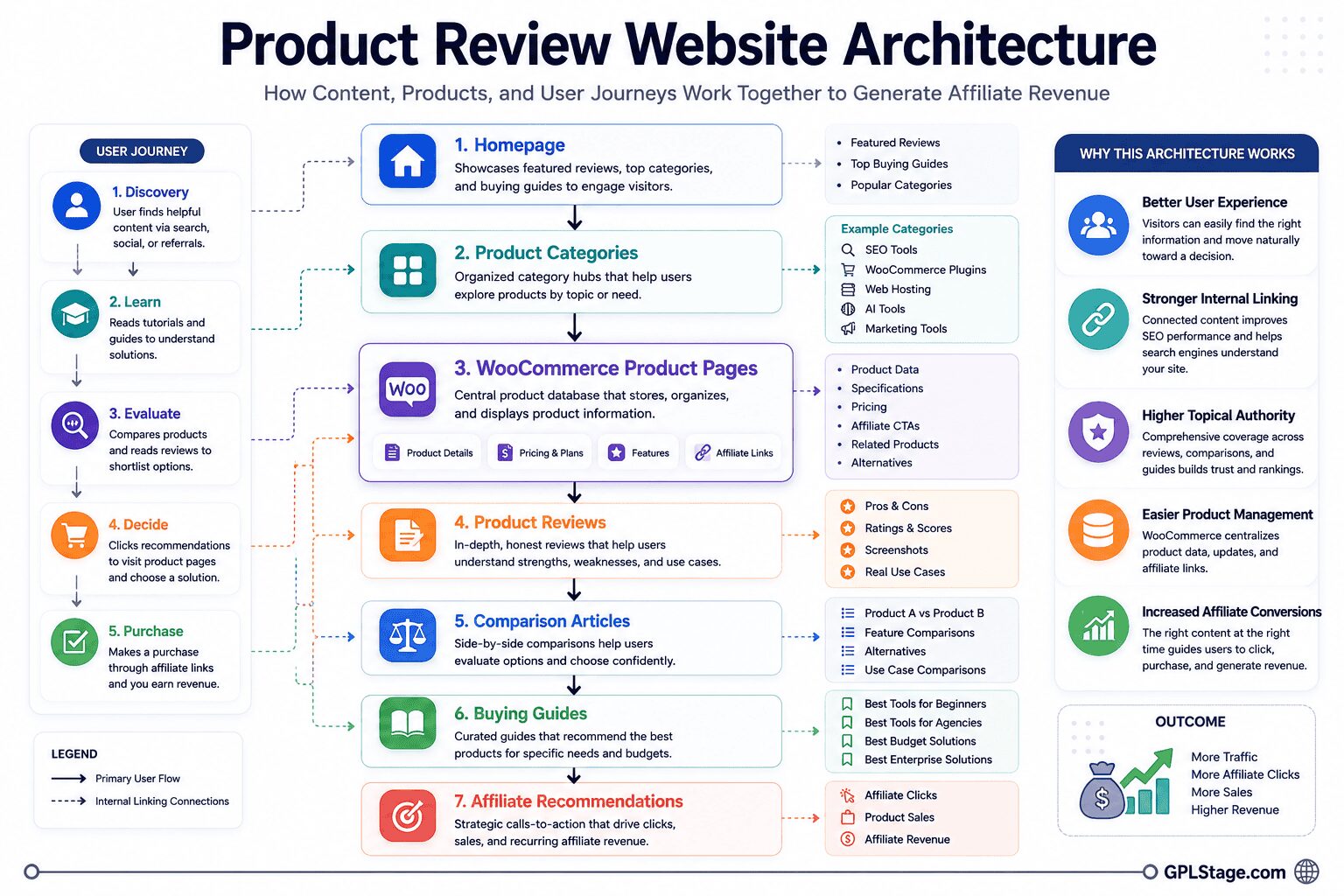
A typical product review website architecture looks like this:
- Homepage
- Product Categories
- Product Pages
- Individual Reviews
- Comparison Articles
- Buying Guides
- Tutorials and Use Cases
- Affiliate Recommendations
This architecture improves user experience because visitors can explore products from multiple angles. Someone may begin with a tutorial, move to a buying guide, compare two products, read a detailed review, and then click through to a merchant website.
Why Architecture Matters for SEO
Sarah Mitchell’s view is simple: search engines are more likely to trust review websites that cover entire product ecosystems, not isolated product mentions.
For example, one review of an SEO plugin may not be enough to build authority. But a complete cluster covering the review, alternatives, setup tutorial, comparison article, pricing guide, and FAQ page sends a much stronger topical signal.
Strong architecture supports:
- Better internal linking
- Stronger topical authority
- Easier navigation
- Improved product discovery
- Higher conversion opportunities
Building a Product Database
Your product database is the operational foundation of your review website.
Without a structured database, every article becomes harder to maintain. With a structured database, content creation, updates, comparisons, and internal linking become easier.
Information to Store for Every Product
| Product Information | Purpose |
|---|---|
| Product Name | Identification |
| Category | Organization |
| Features | Comparison content |
| Pricing | Buying guides |
| Affiliate Link | Monetization |
| Screenshots | Visual content |
| Pros and Cons | Review sections |
| Alternatives | Internal linking |
| Tutorials | Educational content |
Why Product Databases Matter
In practice, product data becomes difficult to manage when it is scattered across many posts. If pricing changes, a screenshot becomes outdated, or a product adds a major feature, you may need to update multiple articles.
A centralized product database reduces that friction. It helps you maintain accurate product information, build comparison content faster, and create better internal links between product pages, reviews, and buying guides.
This is one of the biggest reasons WooCommerce works so well for review websites. It gives your affiliate content a product management layer instead of forcing everything into standard blog posts.
Part 1 Summary
At this stage, you have built the foundation for a scalable product review website.
You now understand:
- Why AI and WooCommerce work well toget her
- How to choose a profitable review niche
- How WooCommerce supports affiliate product management
- Why website architecture matters
- How to structure a product database
The next step is building the content creation system. In Part 2, we will cover how to use AI to create product reviews, comparison articles, buying guides, and content funnels without sacrificing trust or accuracy.
Using AI to Create Product Reviews
AI can significantly speed up product review creation, but it should never replace research, editing, testing, or human judgment. The strongest review websites use AI as a workflow assistant, not as an automatic publishing machine.
In practice, AI is most useful when you already have reliable product information. Once you collect product details, screenshots, pricing, features, use cases, and limitations, AI can help organize that information into a clear review structure.
What AI Should Help With
- Generating review outlines
- Summarizing product features
- Creating first drafts
- Building comparison tables
- Suggesting FAQs
- Refreshing outdated sections
- Creating meta descriptions and title ideas
What AI Should Not Do
- Invent product features
- Replace fact-checking
- Replace product testing
- Publish unedited reviews
- Make unsupported claims
- Write fake personal experience
This distinction matters. A review website built with AI can still be trustworthy, but only when the content is checked, improved, and supported by real product knowledge.
Recommended AI Review Workflow
A practical AI-assisted review workflow looks like this:
- Research the product
- Collect product information
- Generate a review outline
- Create a first draft with AI
- Fact-check features and pricing
- Add screenshots and examples
- Add real-world insights
- Optimize for SEO
- Publish the final review
- Schedule future updates
This workflow gives you speed without sacrificing accuracy. AI helps create the structure, but human review makes the content useful, trustworthy, and publication-ready.
Creating a Standard Product Review Template
One of the easiest ways to scale a review website is to create a repeatable review template. Without a consistent structure, each review becomes harder to write, harder to compare, and harder for readers to scan.
A strong review template helps readers quickly understand what a product does, who it is best for, what it costs, where it performs well, and where it may not be the right fit.
Recommended Product Review Template
| Review Section | Purpose |
|---|---|
| Product Overview | Explain what the product does |
| Key Features | Highlight core functionality |
| Ease of Use | Explain the learning curve and user experience |
| Pricing | Summarize available plans and value |
| Pros and Cons | Show balanced strengths and weaknesses |
| Best Use Cases | Explain who should use the product |
| Alternatives | Suggest competing or related tools |
| Final Verdict | Help readers make a decision |
This template keeps reviews consistent while still allowing room for product-specific details. The goal is not to make every review identical. The goal is to give every review a reliable structure that readers can trust.
Where Human Expertise Adds Value
AI can create a clean first draft, but the final quality depends on what you add after that draft is generated.
- Test the product when possible
- Add screenshots from real usage
- Explain practical workflows
- Compare the product against realistic alternatives
- Identify limitations honestly
- Recommend the product only for the right users
This is where many AI-powered review websites fail. They publish information, but they do not add experience. GPLStage-style content should always go beyond summaries and help users make better decisions.
Creating Product Comparison Content with AI
Product comparison articles are often some of the highest-converting pages on a review website. When someone searches for a query such as “Rank Math vs Yoast SEO” or “best WooCommerce import plugins,” they are usually closer to making a decision than someone searching for a basic product definition.
That makes comparison content extremely valuable for affiliate review websites.
Why Comparison Content Converts Well
A visitor reading a product comparison is not just learning. They are evaluating options. They want to know which product fits their needs, budget, workflow, and experience level.
This is why comparison articles should do more than list features. They should help users choose confidently.
AI-Assisted Comparison Workflow
- Choose the products to compare
- Collect official feature information
- Collect pricing details
- Identify target users for each product
- Generate a comparison outline
- Create a first draft with AI
- Verify all claims manually
- Add expert recommendations
- Publish and update regularly
Recommended Comparison Article Structure
| Section | Purpose |
|---|---|
| Introduction | Explain who the comparison is for |
| Quick Verdict | Provide a fast recommendation |
| Feature Comparison Table | Help readers compare quickly |
| Ease of Use | Compare setup and learning curve |
| Pricing Comparison | Analyze value, not just cost |
| Best For | Explain ideal users for each product |
| Pros and Cons | Show balanced decision factors |
| Final Recommendation | Help readers choose confidently |
AI can help build the structure and first draft, but the recommendation must come from your editorial judgment. Users do not need another generic comparison table. They need a clear explanation of which product is better for their specific situation.
Creating Buying Guides with AI
Buying guides are another core content type for product review websites. They target readers who know they need a solution but have not yet chosen a specific product.
Examples include:
- Best WooCommerce Import Plugins
- Best AI Writing Tools
- Best WordPress Backup Plugins
- Best Email Marketing Platforms
- Best SEO Tools for Small Businesses
These articles can become cornerstone pages because they combine search demand, product recommendations, comparison opportunities, and affiliate monetization.
Recommended Buying Guide Workflow
- Research the keyword and search intent
- Choose evaluation criteria
- Select products to include
- Collect product data
- Generate an outline with AI
- Create the first draft
- Add expert notes and practical recommendations
- Add comparison tables
- Add FAQs
- Publish and monitor performance
Recommended Buying Guide Structure
| Section | Purpose |
|---|---|
| Introduction | Explain the problem and search intent |
| How We Evaluated These Products | Build trust and transparency |
| Quick Recommendations | Help readers choose faster |
| Comparison Table | Summarize important differences |
| Individual Product Reviews | Explain each recommendation |
| Use-Case Recommendations | Match products to user needs |
| FAQs | Answer common buying questions |
| Final Verdict | Summarize the best choices |
A strong buying guide should feel like a decision-support resource, not a random list of products. AI can help speed up drafting, but the final recommendations should be carefully reviewed and aligned with the reader’s intent.
Product Review Content Funnel
Many website owners assume product review websites generate revenue directly from reviews. In reality, successful review websites usually generate revenue through a content funnel.
Different content types serve different stages of the buyer journey. A visitor may first find your website through a tutorial, later read a buying guide, then compare two products, and finally click through from a review or product page.
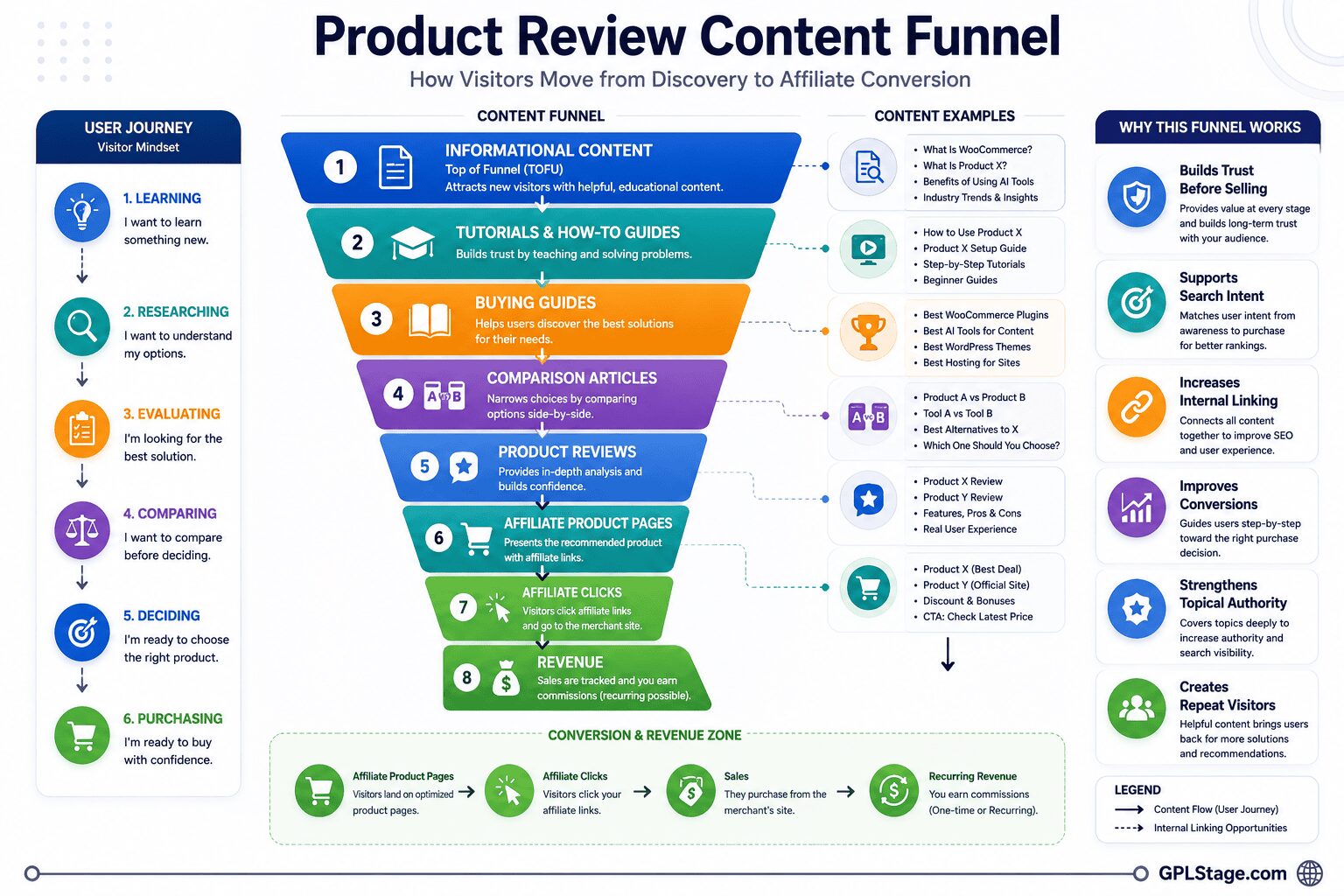
A Simple Product Review Content Funnel
- Informational Content: attracts early-stage visitors
- Tutorials: builds trust and explains workflows
- Buying Guides: helps users explore options
- Comparison Articles: supports product evaluation
- Product Reviews: helps users make decisions
- Affiliate Product Pages: sends users to merchant websites
- Email Follow-Up: brings readers back for future recommendations
This funnel matters because not every visitor is ready to click an affiliate link immediately. Some visitors need education first. Others need comparison. Some need reassurance. A strong review website supports all of these stages.
Why the Funnel Improves Conversions
When content is connected properly, each article helps move the reader closer to a decision. Tutorials build trust. Buying guides organize options. Comparisons clarify differences. Reviews provide final recommendations. Product pages create the conversion path.
This is why review websites should not be built around isolated articles. They should be built around content systems.
Part 2 Summary
At this stage, you have built the content creation system for your review website.
You now understand:
- How to use AI responsibly for product reviews
- Why review templates improve consistency
- How comparison articles support high-intent visitors
- How buying guides become cornerstone content
- Why content funnels improve affiliate conversions
In Part 3, we will move into the SEO and scaling system, including product review SEO, content clusters, AI-assisted content scaling, recommended tools, and automation workflows.
Product Review SEO Best Practices
A product review website without SEO is difficult to grow. Reviews, comparisons, buying guides, alternatives articles, and tutorials all depend on search visibility. If users cannot find your content, even the best review system will struggle to generate affiliate clicks or revenue.
Sarah Mitchell’s approach is simple: do not treat product reviews as isolated articles. Treat them as part of a larger topical authority system.
Focus on Search Intent
Every review article should match a clear search intent. Someone searching for “what is Rank Math” is still learning. Someone searching for “Rank Math vs Yoast SEO” is comparing options. Someone searching for “Rank Math review” may be close to deciding.
Understanding these differences helps you create the right content for the right stage of the buyer journey.
| Search Intent | Example Query | Best Content Type |
|---|---|---|
| Informational | What is Product X? | Tutorial or explainer |
| Commercial Investigation | Product X review | Product review |
| Comparison | Product X vs Product Y | Comparison article |
| Alternatives | Best Product X alternatives | Alternatives guide |
| Buying Intent | Best tools for [use case] | Buying guide |
Build Topical Authority
A single review rarely establishes authority. Search engines are more likely to trust websites that cover an entire product ecosystem through reviews, comparisons, alternatives, tutorials, pricing guides, FAQs, and buying guides.
For example, if you review an SEO plugin, do not stop at one review. Build a complete cluster around it.
- Product review
- Product alternatives
- Product vs competitor comparison
- Product setup tutorial
- Product pricing guide
- Product FAQ article
- Best tools roundup including that product
This helps users explore the topic from multiple angles and gives search engines more context about your expertise.
Keep Reviews Updated
Product review content becomes outdated quickly. Pricing changes. Interfaces change. Features are added or removed. Affiliate terms change. Screenshots become old.
A review website that does not update content will gradually lose trust. Schedule regular updates for your most important pages, especially high-traffic reviews and comparison articles.
- Check pricing pages
- Review feature changes
- Update screenshots
- Refresh pros and cons
- Add new alternatives
- Review affiliate links
- Update publication dates when changes are meaningful
Use Review and FAQ Schema Carefully
Structured data can help search engines understand your content, but it should be used responsibly. Do not add fake ratings, unsupported review scores, or schema that does not match the visible content on the page.
If you use review schema, make sure your review methodology is clear and your ratings are supported by real evaluation criteria.
Building a Content Cluster Around Product Reviews
One product review can attract traffic, but a content cluster builds authority.
A strong review website should connect related content together so users can move naturally between learning, comparing, deciding, and purchasing.
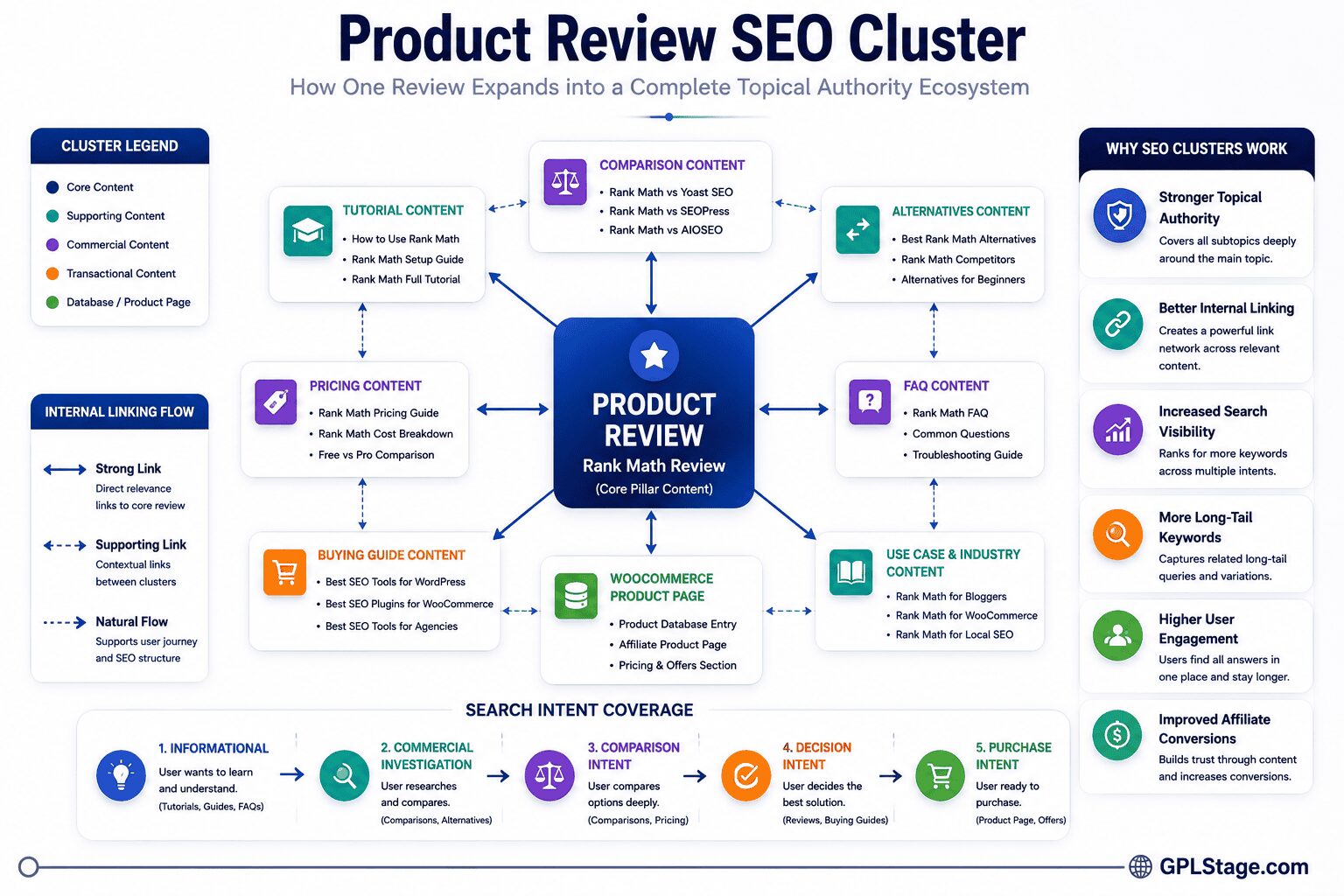
Example Product Review Cluster
- Main Review: Product X Review
- Comparison: Product X vs Product Y
- Alternatives: Best Product X Alternatives
- Tutorial: How to Set Up Product X
- Buying Guide: Best Tools for [Use Case]
- FAQ: Product X Questions Answered
- Product Page: WooCommerce affiliate product page
This cluster gives readers several paths depending on where they are in the buying journey. It also gives you multiple internal linking opportunities, which strengthens SEO and improves user engagement.
Internal Linking Strategy
Internal links should not be random. Every link should help the reader take a logical next step.
- Link reviews to comparisons
- Link comparisons to buying guides
- Link tutorials to product reviews
- Link product pages to related articles
- Link buying guides to individual reviews
This creates a guided experience where readers can continue learning until they are ready to make a decision.
Scaling Content Production with AI
Scaling content production does not mean publishing as much AI content as possible. It means creating a reliable workflow that helps you produce more useful content without losing accuracy or trust.
Emma’s recommendation is to think of AI as a production assistant. It can help with research, outlines, drafts, FAQs, and updates, but it should not become your editorial standard by itself.
Scalable AI Content Workflow
- Choose a product or topic
- Collect reliable product information
- Generate an outline with AI
- Create a first draft
- Verify facts manually
- Add screenshots and examples
- Add expert commentary
- Optimize for search intent
- Publish the content
- Monitor performance
- Refresh the content when needed
This workflow creates a balance between speed and credibility. You produce faster, but you still protect the quality of the website.
Content Refresh Workflow
Updating older content is often more efficient than constantly publishing new articles. A review that already has search visibility may improve significantly after you update features, pricing, screenshots, internal links, and comparison sections.
- Identify outdated content
- Check product changes
- Update pricing and screenshots
- Add new competitors or alternatives
- Refresh FAQs
- Improve internal links
- Republish with meaningful updates
This is where AI can be especially useful. It can help summarize changes, suggest missing sections, and organize updates, while you verify the final accuracy.
Recommended AI + WooCommerce Review Website Tool Stack
A product review website does not need dozens of tools to succeed. It needs a practical stack that supports content creation, product management, SEO, analytics, and automation.
| System | Recommended Tool Type | Purpose |
|---|---|---|
| Website Platform | WordPress | Website foundation |
| Product Management | WooCommerce | Product catalog and affiliate products |
| SEO | SEO plugin | Metadata, schema, indexing, and optimization |
| Product Imports | WooCommerce import tool | Bulk product creation and updates |
| Analytics | Analytics and Search Console tools | Traffic and performance tracking |
| Email Marketing | Email platform | Subscriber capture and campaigns |
| AI Workflow | AI writing and research tools | Research, outlines, drafts, and refreshes |
| Automation | Workflow automation tools | Process automation and notifications |
The goal is not to build a complicated stack. The goal is to build a system that you can maintain consistently.
Automation Workflows for Review Websites
As your review website grows, manual management becomes increasingly difficult. Publishing content is only one part of the business. You must also manage products, affiliate links, updates, analytics, internal links, and email marketing.
Automation helps turn those repeated tasks into manageable workflows.
Affiliate Product Import Automation
If your review website includes many affiliate products, product import automation can save significant time. Instead of manually creating every product, you can import product data from CSV files, XML feeds, APIs, or affiliate networks when available.
A typical product import workflow looks like this:
- Affiliate network or product source
- Product feed
- WooCommerce import tool
- WooCommerce product database
- Review and comparison content
- Affiliate recommendations
Email Marketing Automation
Many review websites depend entirely on search traffic. That creates risk because rankings can change. Email marketing gives you a direct audience that you can reach again.
Useful email automations include:
- Welcome sequences
- New review alerts
- Buying guide campaigns
- Product recommendation emails
- Re-engagement campaigns
Analytics and Performance Monitoring
Successful review websites track what works. That includes traffic, affiliate clicks, conversions, top-performing reviews, underperforming pages, and revenue sources.
Analytics helps you make better decisions. Instead of guessing which products deserve more attention, you can identify which reviews, comparisons, and buying guides already perform well and improve them further.
Product Review Website Automation Ecosystem
A mature review website is not powered by one tool. It is powered by connected systems.
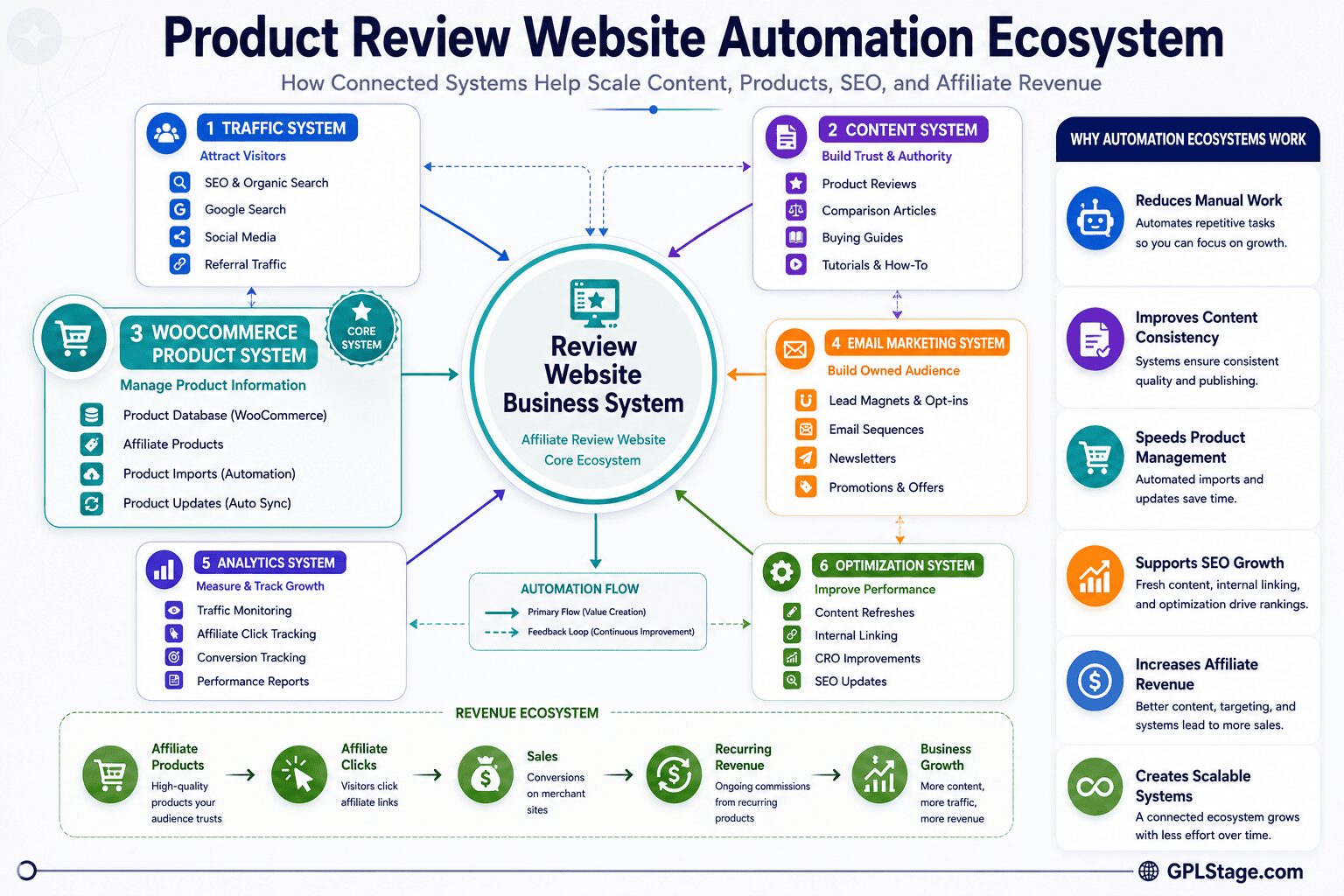
A strong automation ecosystem may include:
- Traffic System: SEO, social traffic, referrals, and content distribution
- Content System: reviews, comparisons, buying guides, tutorials, and updates
- Product System: WooCommerce catalog, affiliate links, imports, and product updates
- Email System: subscriber capture, newsletters, sequences, and promotions
- Analytics System: traffic, affiliate clicks, conversions, and revenue tracking
- Optimization System: content refreshes, internal linking, CRO, and product updates
The purpose of automation is not to create a “set it and forget it” website. That mindset leads to low-quality content and outdated recommendations.
The real purpose is to reduce repetitive work so you can focus on improving content quality, user experience, and revenue strategy.
Part 3 Summary
At this stage, you have built the SEO and scaling system for your product review website.
You now understand:
- How search intent shapes review content
- Why topical authority matters
- How content clusters improve SEO
- How AI can scale content responsibly
- Which systems support review website growth
- How automation reduces repetitive work
In Part 4, we will cover monetization, review methodology, realistic growth expectations, common mistakes, FAQs, the build checklist, and the final conclusion.
Monetization Strategies for Product Review Websites
Many new website owners focus exclusively on affiliate commissions. While affiliate marketing is often the primary revenue source for review websites, relying on a single income stream creates unnecessary risk.
The strongest review websites typically combine multiple monetization strategies. This creates a more stable business and allows revenue to grow alongside traffic and authority.
Affiliate Programs
Affiliate marketing remains the foundation of most review websites. By recommending products that solve real problems, you can earn commissions when visitors make purchases through your referral links.
Focus on products that:
- Match your audience’s needs
- Have strong reputations
- Offer quality support
- Provide fair commissions
- Continue improving over time
Long-term trust is more valuable than short-term commissions. Recommending poor products can damage your reputation and reduce future conversions.
Sponsored Content and Partnerships
As your website gains authority, companies may approach you for sponsored reviews, product placements, or partnership opportunities.
Transparency is essential. Always disclose sponsored relationships and maintain editorial independence. Readers trust review websites because they expect honest recommendations.
Display Advertising
Display advertising can supplement affiliate revenue, particularly on informational content and tutorials that attract large amounts of traffic.
Advertising works best when:
- Traffic volume is growing
- Content attracts broad audiences
- User experience remains a priority
Email Marketing Revenue
Email subscribers often become repeat visitors and repeat buyers. A strong email strategy allows you to recommend products, promote new reviews, share buying guides, and drive recurring traffic.
Unlike search traffic, your email list is an asset you control directly.
Digital Products
As your expertise grows, consider creating your own products.
- Templates
- Checklists
- Courses
- Workshops
- Premium guides
- Resource libraries
Digital products diversify revenue while strengthening your authority within the niche.
Consulting and Services
Many successful review websites eventually generate consulting opportunities.
For example:
- WordPress consulting
- WooCommerce consulting
- SEO consulting
- Marketing automation consulting
- AI workflow consulting
These services often emerge naturally as readers begin viewing you as a trusted expert.
Product Review Methodology Framework
One of the biggest problems with modern review websites is credibility. Readers want to know why a product was recommended and how it was evaluated.
A transparent review methodology helps build trust and strengthens EEAT signals.
Example Product Evaluation Framework
| Evaluation Area | Weight |
|---|---|
| Features | 25% |
| Ease of Use | 20% |
| Value for Money | 20% |
| Performance | 15% |
| Support & Documentation | 10% |
| Integrations | 10% |
Publishing your methodology helps readers understand how recommendations are made and why certain products rank higher than others.
Best Practices for Product Evaluation
- Use products whenever possible
- Capture screenshots
- Document real workflows
- Identify limitations honestly
- Compare products fairly
- Update evaluations when products change
Trust is built through transparency, not through claiming every product is perfect.
Realistic Growth Expectations
One of the most common mistakes new affiliate website owners make is expecting immediate traffic and revenue.
Successful review websites usually grow through predictable stages. Understanding these stages helps set realistic expectations and encourages long-term thinking.
Stage 1: Foundation
0–100 Monthly Visitors
- Website setup
- Product database creation
- Initial content publishing
- Basic SEO implementation
Goal: Build the foundation.
Stage 2: Growth
100–1,000 Monthly Visitors
- Internal linking
- Comparison articles
- Buying guides
- Email subscriber growth
Goal: Generate the first affiliate commissions.
Stage 3: Scaling
1,000–10,000 Monthly Visitors
- Automation implementation
- Product imports
- Content expansion
- Conversion optimization
Goal: Build repeatable systems.
Stage 4: Expansion
10,000–50,000 Monthly Visitors
- Email marketing
- Revenue diversification
- Analytics-driven optimization
- Process improvement
Goal: Create predictable revenue.
Stage 5: Authority
50,000+ Monthly Visitors
- Strategic partnerships
- Digital products
- Sponsored opportunities
- Advanced automation
Goal: Operate a scalable digital business.
Product Review Revenue Growth Roadmap
Traffic alone does not create a successful review website. Revenue growth comes from improving how visitors move through your content ecosystem.
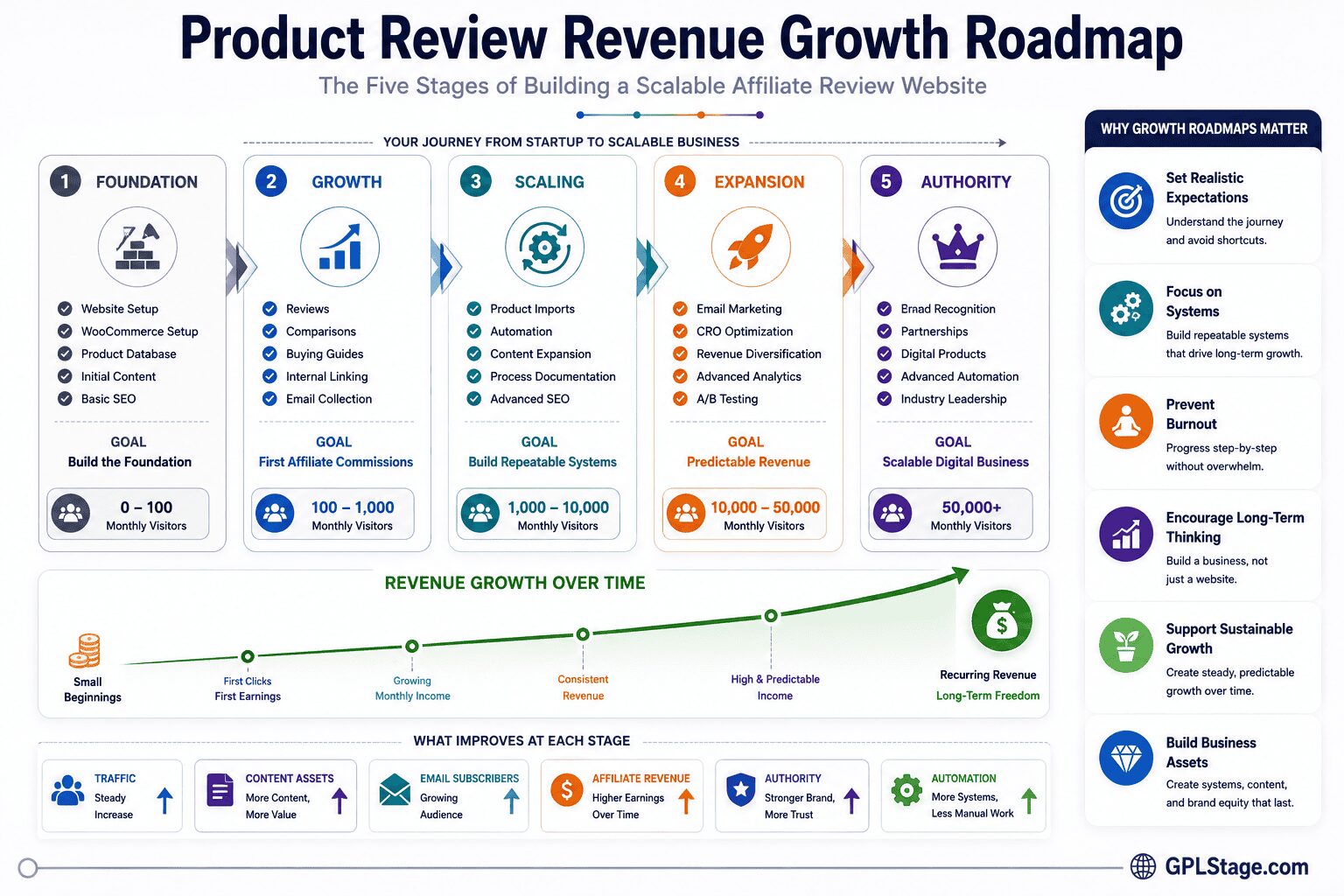
A simplified revenue roadmap looks like this:
- Publish educational content
- Build topical authority
- Increase organic traffic
- Grow your email list
- Create comparison content
- Improve affiliate click-through rates
- Diversify revenue streams
- Launch digital products and partnerships
The websites that grow fastest are usually the ones that improve systems rather than chasing shortcuts.
Common Mistakes to Avoid
Publishing Unedited AI Content
AI-generated drafts should always be reviewed, improved, and verified before publication.
Creating Thin Reviews
Readers expect detailed analysis, comparisons, use cases, and honest recommendations.
Ignoring Search Intent
Every piece of content should solve a specific user problem.
Focusing Only on Reviews
Successful review websites also publish comparisons, alternatives, tutorials, FAQs, and buying guides.
Neglecting Email Marketing
Email subscribers remain one of the most valuable assets a review website can build.
Failing to Update Content
Outdated reviews eventually lose trust, rankings, and conversion opportunities.
Frequently Asked Questions
Can AI create product reviews automatically?
AI can assist with research summaries, outlines, drafts, FAQs, and updates, but human review remains essential for accuracy, trust, and quality.
Is WooCommerce suitable for affiliate review websites?
Yes. WooCommerce can function as a structured product management system that supports reviews, comparisons, buying guides, and affiliate product pages.
How many reviews should a new website publish?
Focus on quality before quantity. A small collection of comprehensive reviews usually performs better than dozens of thin articles.
Do comparison articles convert better than reviews?
Often, yes. Visitors reading comparison articles are usually closer to making a purchase decision.
Is AI-generated content bad for SEO?
No. Low-quality content is bad for SEO. AI-assisted content can perform well when it is accurate, useful, reviewed, and supported by expertise.
Should I test products myself?
Whenever possible, yes. First-hand experience improves credibility, trust, and content quality.
Affiliate Review Website Build Checklist
| Task | Completed |
|---|---|
| Choose niche | ⬜ |
| Register domain | ⬜ |
| Configure hosting | ⬜ |
| Install WooCommerce | ⬜ |
| Configure affiliate products | ⬜ |
| Import products | ⬜ |
| Create content | ⬜ |
| Configure SEO | ⬜ |
| Build email list | ⬜ |
| Implement automation | ⬜ |
Final Thoughts
Building a successful product review website is no longer just about publishing reviews. The strongest websites combine structured product management, content marketing, search engine optimization, automation, email marketing, analytics, and user-focused recommendations.
AI can accelerate research, planning, drafting, and content maintenance. WooCommerce provides the structure needed to organize products and scale efficiently. Together, they create a powerful foundation for building a review website business rather than simply a collection of articles.
The websites that succeed over the long term are not necessarily the ones that publish the most content. They are the ones that consistently provide the most useful content, maintain accurate product information, and help users make better purchasing decisions.
Conclusion
AI and WooCommerce provide a powerful framework for building modern product review websites.
By combining structured product management, AI-assisted content workflows, strong SEO practices, automation systems, and diversified monetization strategies, you can create a scalable affiliate business capable of generating long-term traffic, commissions, and business growth.
Start with a profitable niche. Build a structured product database. Create genuinely helpful reviews and comparisons. Implement automation gradually. Focus on trust, accuracy, and user value.
Over time, these systems can transform a simple review website into a valuable digital asset that continues growing long after the first article is published.