By Emma Richardson — Senior WordPress Automation & Digital Business Systems Specialist
Technical Review & WooCommerce Implementation Guidance by Michael Carter — Senior WooCommerce Developer & eCommerce Solutions Specialist
Affiliate marketing has evolved far beyond publishing random product reviews and hoping for commissions. Today’s successful affiliate websites operate like digital businesses, combining content marketing, product discovery, automation, SEO, and conversion optimization into a scalable system.
WooCommerce provides one of the most powerful foundations for building that system. While many affiliate marketers rely on traditional blogs, WooCommerce allows you to create structured product catalogs, automate product management, organize buying guides, and build a professional affiliate platform that can scale from a handful of products to thousands.
This guide will show you how to build a scalable affiliate website with WooCommerce, from choosing a niche and setting up your website to automating product imports, generating traffic, and creating a long-term affiliate business.
Understanding the Affiliate Website Business Model
Before installing WordPress or WooCommerce, it’s important to understand what you’re actually building.
An affiliate website is not simply a collection of affiliate links.
A successful affiliate website is a business system consisting of:
- Product discovery
- Content marketing
- Search engine traffic
- Product recommendations
- Conversion funnels
- Affiliate partnerships
- Revenue optimization
The goal is to help visitors make informed purchasing decisions while earning commissions from products you recommend.
Many beginners think affiliate marketing is simply adding affiliate links to blog posts. In reality, successful affiliate websites operate as complete business systems that combine traffic generation, content creation, product recommendations, email marketing, and conversion optimization. The blueprint below illustrates how these systems work together to create sustainable affiliate revenue.
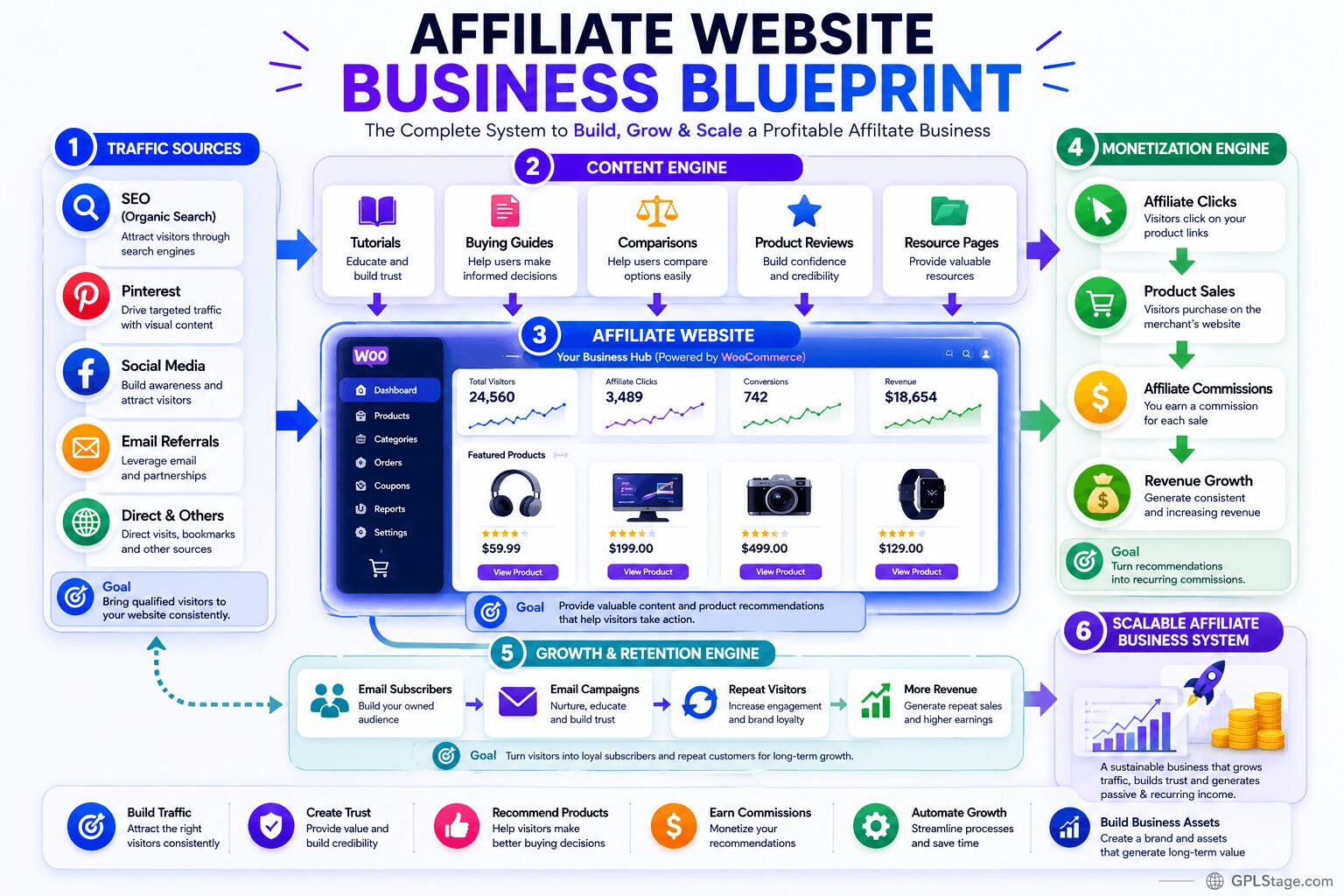
The most successful affiliate websites focus on building long-term business assets rather than chasing quick commissions. By combining SEO, content marketing, WooCommerce product management, email marketing, and automation, affiliate businesses can scale traffic, improve conversions, and generate more consistent revenue over time.
Why WooCommerce Is Ideal for Affiliate Websites
Most affiliate websites are built using blog posts alone.
However, WooCommerce offers several advantages.
WooCommerce Affiliate Website vs Traditional Affiliate Blog
| WooCommerce Affiliate Website | Traditional Affiliate Blog |
|---|---|
| Product catalogs | Individual articles |
| Product filtering | Limited filtering |
| Product collections | Difficult to manage |
| Product imports | Often manual |
| Automation opportunities | Limited |
| Easier scaling | Harder scaling |
| Better product discovery | Content-focused navigation |
For websites promoting dozens or hundreds of products, WooCommerce creates a significantly better user experience.
Phase 1: Choose a Profitable Affiliate Niche
Your niche determines:
- Revenue potential
- Competition level
- Content opportunities
- Long-term growth
The best niches combine:
✔ buyer intent
✔ recurring demand
✔ multiple affiliate programs
✔ quality products
Best Affiliate Niches for WooCommerce
| Niche | Competition | Commission Potential | Scalability |
|---|---|---|---|
| WordPress Plugins | Medium | High | Excellent |
| Web Hosting | High | Very High | Excellent |
| SaaS Tools | Medium | High | Excellent |
| AI Software | Medium | High | Excellent |
| Online Courses | Medium | High | Good |
| Productivity Tools | Medium | Medium | Excellent |
Choose a niche you can realistically create content about for years.
Phase 2: Build the WooCommerce Infrastructure
This is where Michael Carter’s expertise becomes critical.
Register a Domain and Hosting
Choose a domain that:
- is brandable
- supports future growth
- reflects your niche
Hosting should prioritize:
- WooCommerce performance
- scalability
- SSL security
- backups
- reliability
Install WordPress and WooCommerce
Once hosting is ready:
- Install WordPress
- Install WooCommerce
- Configure store pages
- Set permalink structure
- Configure categories
Although you’re promoting affiliate products, WooCommerce becomes your product management system.
Configure Affiliate Products
WooCommerce includes:
External/Affiliate Products
This allows you to:
- display products
- add affiliate URLs
- customize CTA buttons
- organize product catalogs
Visitors click your affiliate link and complete purchases on the merchant’s website.
Recommended WooCommerce Affiliate Website Structure
Home Page
↓
Category Pages
↓
Product Collections
↓
Buying Guides
↓
Comparison Articles
↓
Product Reviews
↓
Affiliate Product Pages
↓
Conversions
This architecture supports both SEO and user experience.
Website architecture is one of the most overlooked aspects of affiliate website success. A well-structured WooCommerce affiliate website improves user experience, strengthens internal linking, supports topical authority, and helps search engines understand how your content and products are connected. The architecture below demonstrates a scalable framework for organizing an affiliate website.
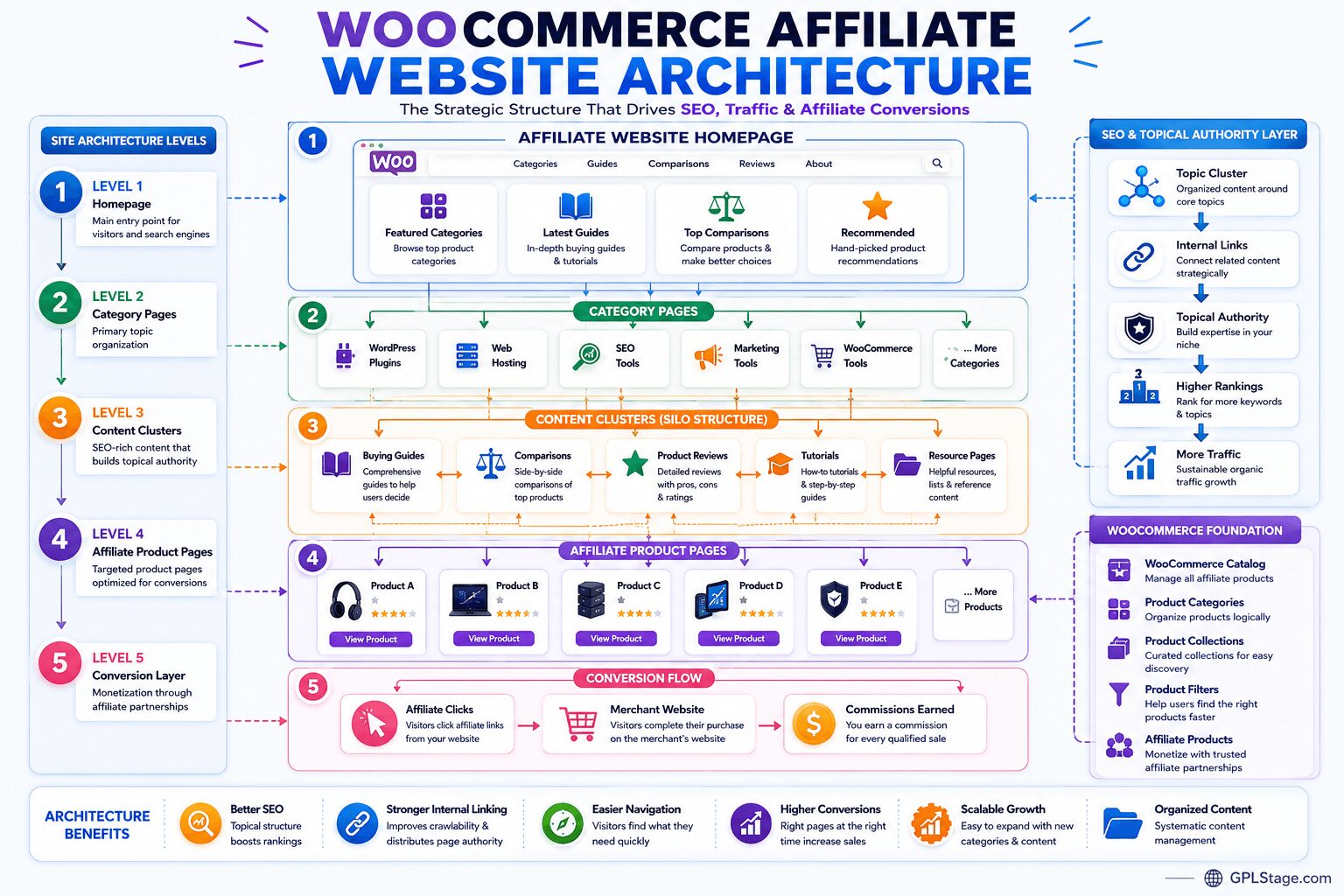
Successful affiliate websites are built around topic clusters, strategic internal linking, and organized product catalogs rather than isolated blog posts. By creating a logical hierarchy between category pages, content assets, affiliate product pages, and conversion paths, you make it easier for visitors and search engines to navigate your website.
Phase 3: Build the Product Management System
Most affiliate websites eventually face the same challenge:
Managing products manually becomes difficult.
Affiliate Product Import Workflow
Supplier Feed
↓
Import Plugin
↓
WooCommerce Catalog
↓
SEO Content
↓
Affiliate Clicks
↓
Commission Revenue
This workflow becomes increasingly valuable as product catalogs grow.
Managing affiliate products at scale requires more than manually adding products to WooCommerce. Successful affiliate websites use structured import workflows that connect supplier feeds, product catalogs, content assets, and conversion systems. The workflow below demonstrates how modern WooCommerce affiliate websites automate product management while supporting SEO and affiliate revenue growth.
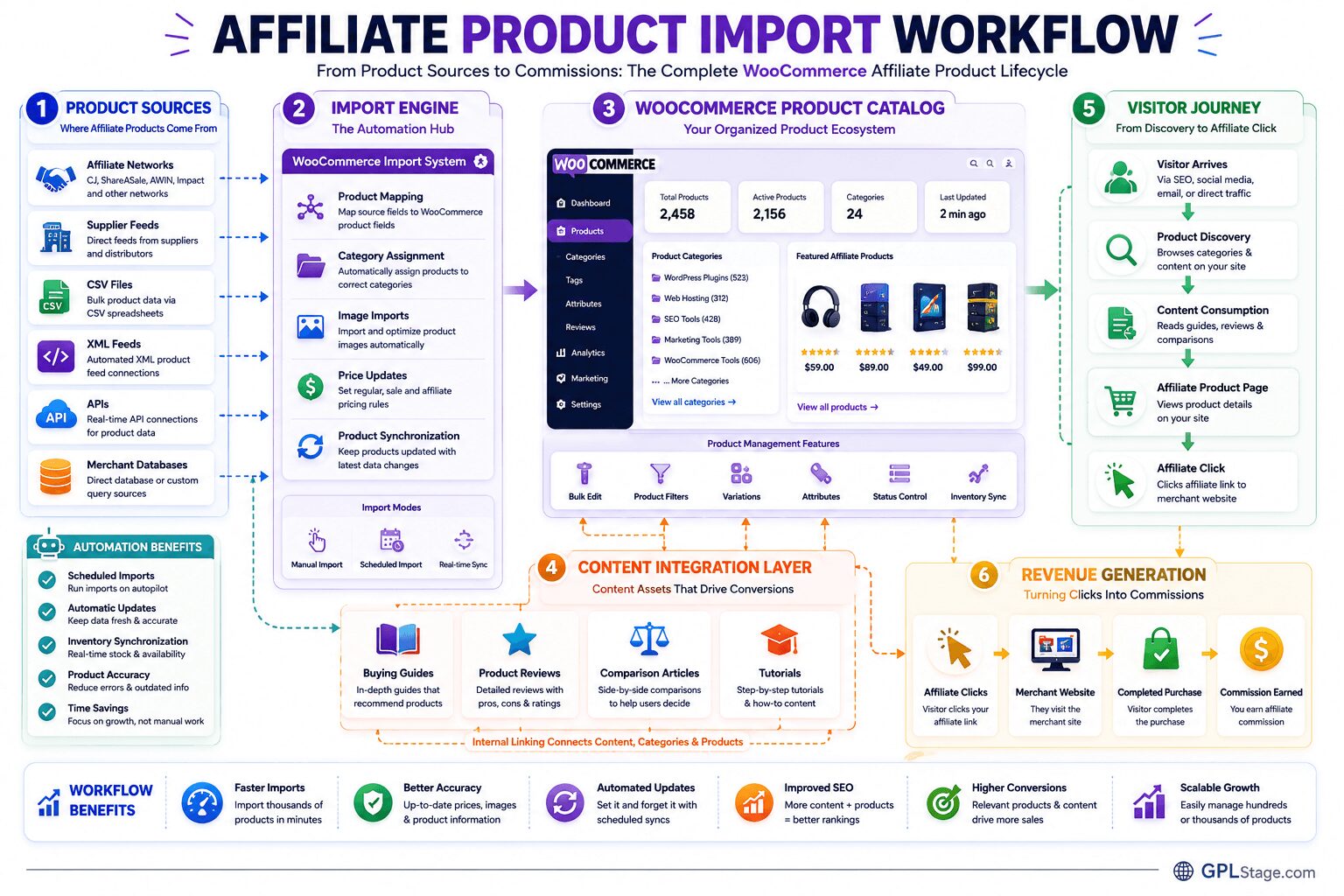
An effective affiliate product workflow combines product imports, content creation, visitor engagement, and automation into a unified system. By connecting WooCommerce product catalogs with buying guides, reviews, comparisons, and tutorials, affiliate websites can improve product visibility, increase conversions, and reduce operational workload.
Import Affiliate Products Efficiently
Large affiliate websites often use:
- CSV feeds
- XML feeds
- APIs
- supplier feeds
- affiliate network feeds
Automation can handle:
- product creation
- image imports
- category assignment
- product updates
- synchronization
Recommended Reading:
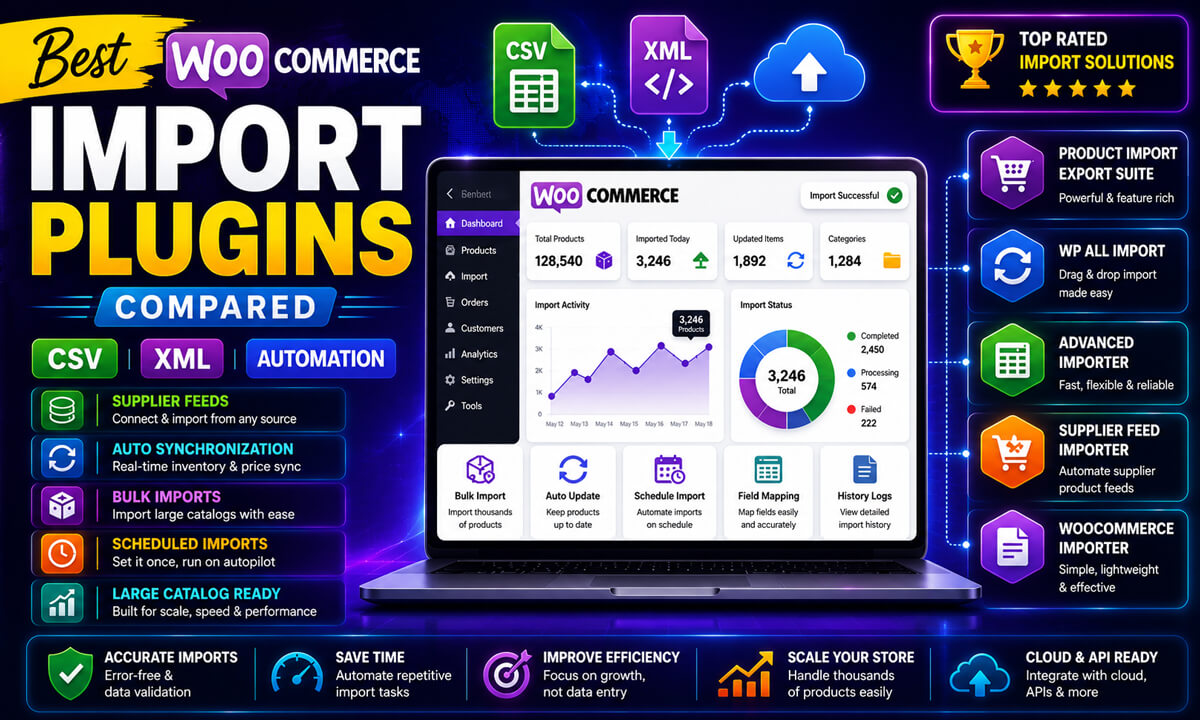
Best WooCommerce Product Import Plugins Compared
How Product Catalogs Scale
Small Catalog
50–100 products
Usually manageable manually.
Medium Catalog
100–1,000 products
Automation becomes highly valuable.
Large Catalog
1,000+ products
Automation becomes essential.
At this stage, scheduled imports and synchronization systems significantly reduce maintenance effort.
Phase 4: Build the Traffic System
Most affiliate websites fail because they focus only on products.
Successful affiliate businesses focus on traffic.
Content Types That Drive Affiliate Revenue
Product Reviews
Examples:
- Rank Math Review
- Elementor Review
Comparison Articles
Examples:
- Elementor vs Divi
- Rank Math vs Yoast
Buying Guides
Examples:
- Best WooCommerce Import Plugins
- Best WordPress Hosting
Tutorials
Examples:
- How to Build an Online Store
- How to Speed Up WordPress
Tutorials often generate the most consistent traffic over time.
Affiliate Content Funnel
Many affiliate websites publish content without a clear strategy for moving visitors toward purchasing decisions.
The most successful affiliate businesses build structured content funnels.
Awareness Stage
Content Examples:
- tutorials
- educational articles
- beginner guides
Goal:
Attract new visitors through search engines.
Consideration Stage
Content Examples:
- product comparisons
- alternatives articles
- feature comparisons
Goal:
Help users evaluate options.
Decision Stage
Content Examples:
- product reviews
- buying guides
- product pages
Goal:
Help visitors make purchasing decisions confidently.
Conversion Stage
Content Examples:
- affiliate product pages
- deal pages
- resource pages
Goal:
Generate affiliate clicks and commissions.
Affiliate Content Funnel Example
SEO Traffic
↓
Tutorial
↓
Buying Guide
↓
Comparison Article
↓
Product Review
↓
Affiliate Product Page
↓
Affiliate Click
↓
Commission Revenue
This structured approach often outperforms publishing random affiliate content.
Successful affiliate websites rarely generate commissions from a single article. Instead, visitors move through a content funnel that builds trust, helps them evaluate solutions, and guides them toward purchasing decisions. The funnel below demonstrates how different content types support each stage of the affiliate customer journey.
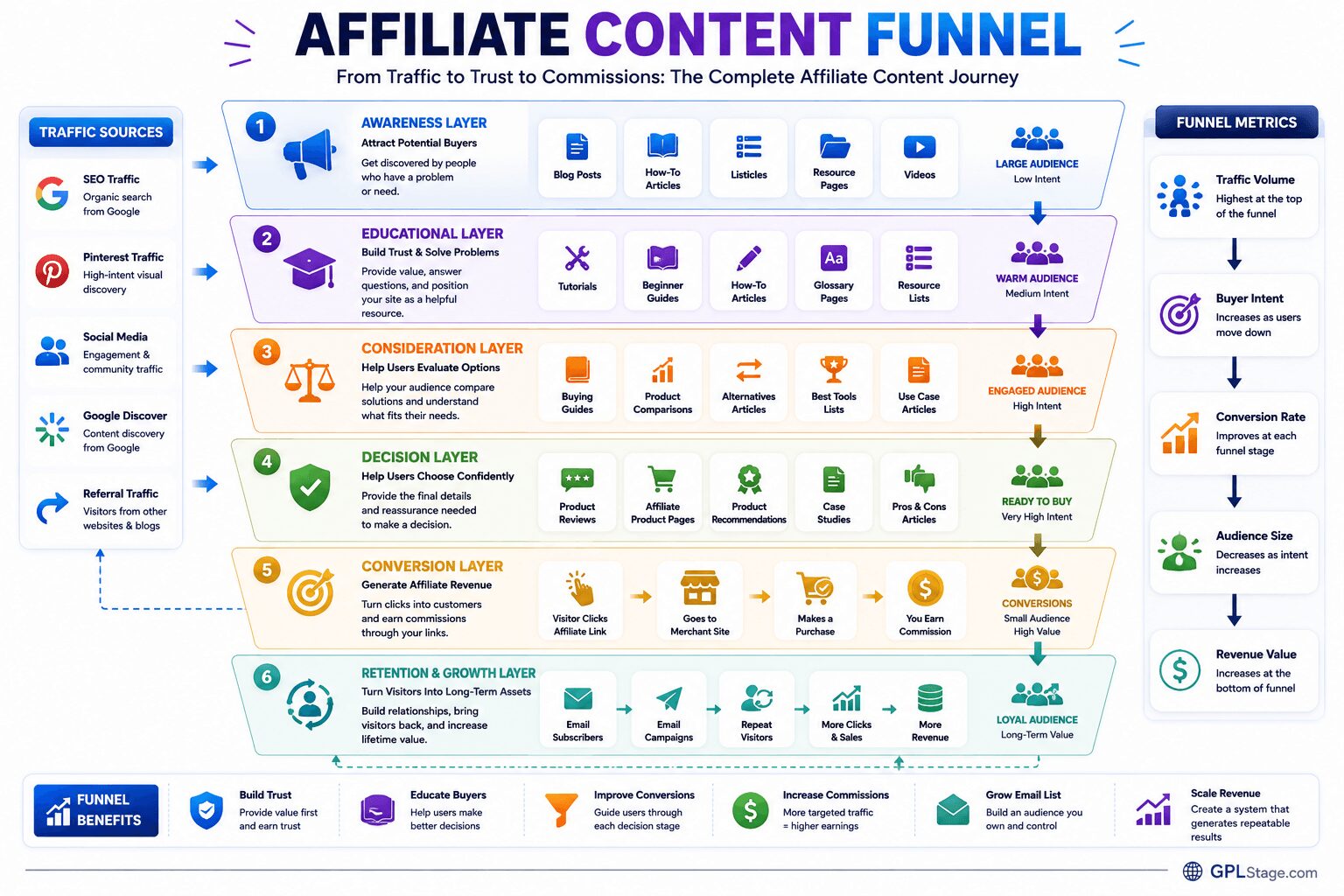
The most effective affiliate websites combine educational content, buying guides, comparisons, reviews, and email marketing into a structured conversion system. As visitors move through the funnel, buyer intent increases, conversion rates improve, and affiliate revenue opportunities grow.
Build Topical Authority
Instead of publishing random content, create topic clusters.
Example:
WordPress Plugin Cluster
- Plugin Reviews
- Plugin Comparisons
- Setup Tutorials
- Troubleshooting Guides
- Buying Guides
This improves SEO and builds authority.
Phase 5: Build the Conversion System
Traffic alone doesn’t create revenue.
Visitors must become buyers.
Create Affiliate Content Funnels
A typical affiliate funnel:
SEO Traffic
↓
Educational Content
↓
Comparison Article
↓
Product Recommendation
↓
Affiliate Click
↓
Commission
The best affiliate websites help users make confident purchasing decisions.
Build an Email List Early
One of the biggest mistakes affiliate marketers make is relying entirely on Google traffic.
Create lead magnets such as:
- checklists
- templates
- guides
- resource libraries
Collect email subscribers and build long-term relationships with your audience.
Affiliate Website Monetization Models
Affiliate commissions should not be your only revenue source.
Many successful websites combine:
- Affiliate marketing
- Sponsored content
- Lead generation
- Digital products
- Memberships
- Email promotions
This diversification improves long-term stability.
Phase 6: Automate and Scale
Automation is where affiliate websites become businesses.
Affiliate Website Automation Ecosystem
Automation is not limited to importing products.
As affiliate websites grow, multiple systems begin working together.
A mature affiliate website automation ecosystem typically includes:
Traffic System
- SEO
- content publishing
- internal linking
Product Management System
- product imports
- synchronization
- feed management
Email Marketing System
- subscriber capture
- automated email sequences
- newsletter distribution
Analytics System
- affiliate click tracking
- traffic monitoring
- conversion analysis
Optimization System
- content updates
- product updates
- conversion improvements
Affiliate Business Automation Workflow
Traffic
↓
Content
↓
Email Capture
↓
Affiliate Product Recommendations
↓
Affiliate Clicks
↓
Revenue
↓
Analytics
↓
Optimization
↓
Growth
The more these systems work together, the more scalable and efficient your affiliate business becomes.
As affiliate websites grow, managing products, content, traffic, email marketing, and performance manually becomes increasingly difficult. Successful affiliate businesses rely on connected systems that automate repetitive tasks, improve efficiency, and create scalable growth. The ecosystem below illustrates how these business systems work together.
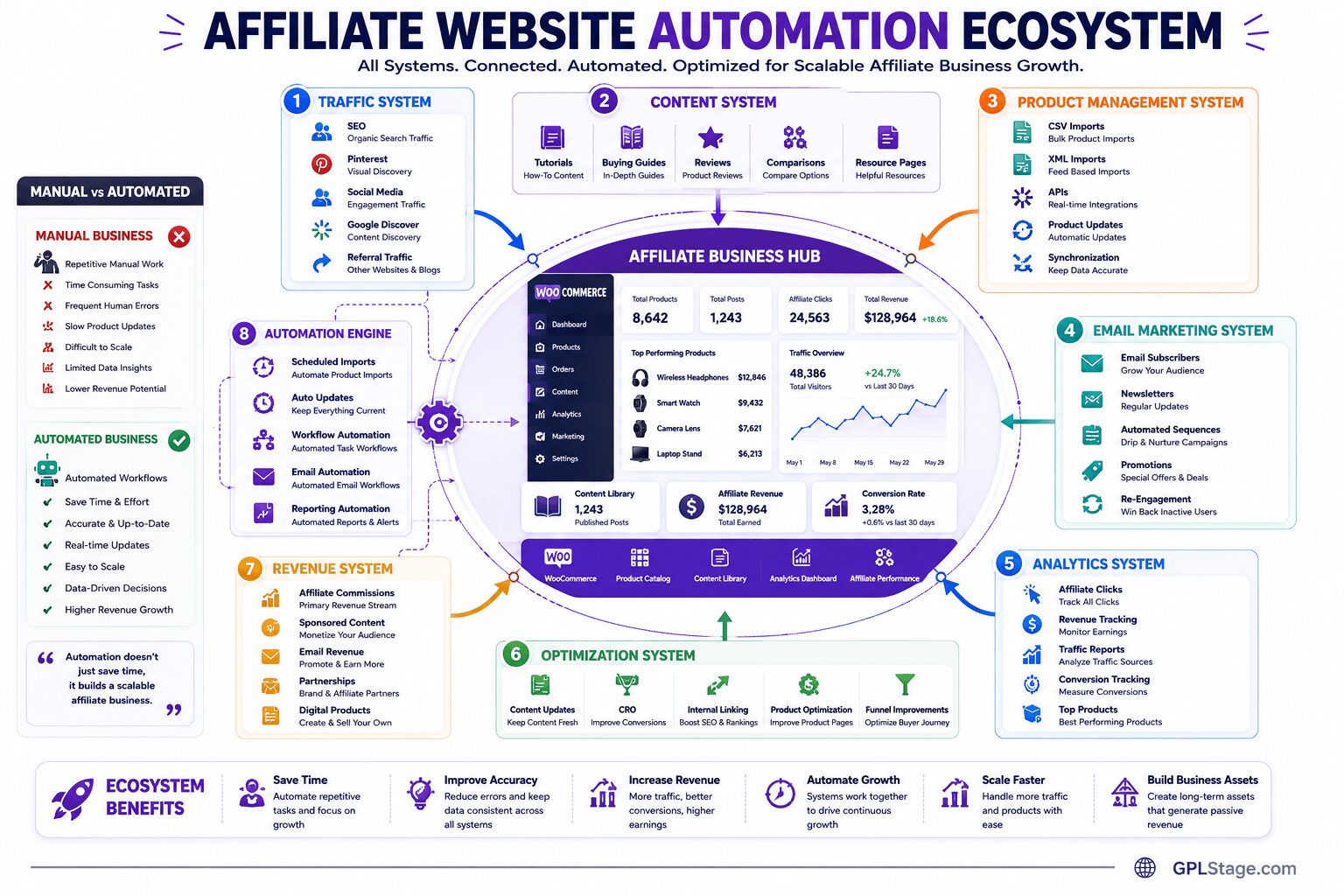
A mature affiliate business operates as an interconnected ecosystem rather than a collection of isolated tasks. By combining WooCommerce product management, content marketing, email automation, analytics, optimization, and traffic generation, website owners can reduce manual workload while improving long-term growth and revenue potential.
Manual vs Automated Product Management
| Manual | Automated |
|---|---|
| Product-by-product updates | Bulk updates |
| Manual imports | Scheduled imports |
| Higher error risk | Better consistency |
| Difficult scaling | Easier scaling |
| Time consuming | Efficient workflows |
Recommended Reading:
Manual vs Automated Product Management
Recommended Affiliate Website Technology Stack
Website Platform
WooCommerce
SEO
Rank Math
Caching
WP Rocket
Image Optimization
ShortPixel
Security
Wordfence
Product Imports
WP All Import
Automation
Import scheduling and synchronization tools
Affiliate Website Build Checklist
| Task | Completed |
|---|---|
| Choose niche | ⬜ |
| Register domain | ⬜ |
| Configure hosting | ⬜ |
| Install WooCommerce | ⬜ |
| Configure affiliate products | ⬜ |
| Import products | ⬜ |
| Create content | ⬜ |
| Configure SEO | ⬜ |
| Build email list | ⬜ |
| Implement automation | ⬜ |
Common Affiliate Website Mistakes
Chasing Too Many Niches
Focus builds authority.
Thin Product Pages
Add unique value beyond manufacturer descriptions.
Ignoring SEO
Search traffic remains a major affiliate growth channel.
Ignoring Automation
Manual workflows become unsustainable as websites grow.
No Email Strategy
Email lists create long-term business assets.
Educational Compliance and Affiliate Disclosure
Always disclose affiliate relationships clearly.
Example:
“We may earn a commission if you purchase through links on this page. This helps support our content at no additional cost to you.”
Transparency improves trust and compliance.
Scaling Beyond Your First 1,000 Products
Once your affiliate website grows:
- expand content clusters
- improve automation
- diversify traffic sources
- strengthen email marketing
- optimize conversions
- build operational workflows
At this stage, you’re no longer managing a website.
You’re operating a digital business system.
Affiliate Website Revenue Growth Roadmap
One of the biggest mistakes new affiliate marketers make is expecting significant revenue immediately.
Successful affiliate websites typically grow through predictable stages.
Stage 1: Foundation (0–100 Monthly Visitors)
Focus on:
- choosing a niche
- building your website
- publishing initial content
- learning SEO fundamentals
Goals:
✔ publish content consistently
✔ build topical relevance
✔ establish website structure
At this stage, revenue is usually minimal.
Stage 2: Growth (100–1,000 Monthly Visitors)
Focus on:
- creating buying guides
- publishing comparison articles
- improving internal linking
- collecting email subscribers
Goals:
✔ improve rankings
✔ build trust
✔ generate first affiliate commissions
This stage often validates your niche and content strategy.
Stage 3: Scaling (1,000–10,000 Monthly Visitors)
Focus on:
- expanding content clusters
- automating product management
- optimizing affiliate funnels
- improving conversion rates
Goals:
✔ increase affiliate clicks
✔ improve user engagement
✔ reduce operational workload
Automation becomes increasingly valuable during this phase.
Stage 4: Business Expansion (10,000+ Monthly Visitors)
Focus on:
- monetization diversification
- email marketing
- partnerships
- advanced automation
Goals:
✔ create predictable revenue
✔ reduce dependence on a single traffic source
✔ build long-term business assets
At this stage, you’re operating a digital business rather than simply running a website.
Building a successful affiliate website is a long-term process that evolves through multiple stages. As traffic, content, authority, automation, and revenue systems grow, website owners must shift their focus from setup and content creation to optimization, diversification, and business scalability. The roadmap below illustrates a realistic affiliate business growth journey.
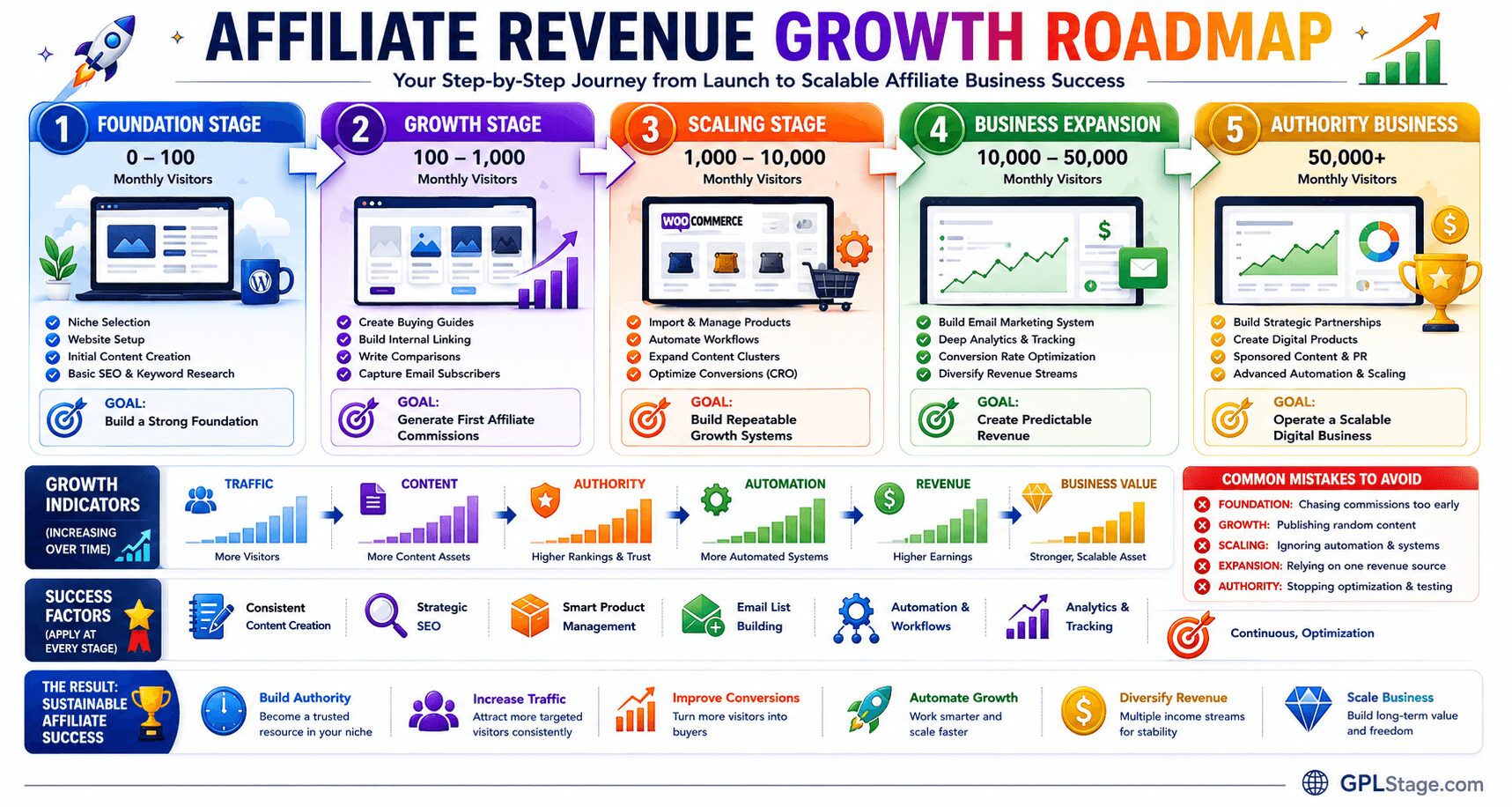
Most successful affiliate websites do not grow because of a single tactic. Sustainable growth comes from consistently publishing valuable content, improving SEO, implementing automation, building email marketing systems, and optimizing conversion pathways over time. Each stage of the roadmap introduces new priorities that help transform a website into a scalable digital business.
Recommended Next Steps
Continue building your affiliate ecosystem with:
- Best WooCommerce Product Import Plugins Compared
- WooCommerce Affiliate Store Automation Guide
- WooCommerce Affiliate Website SEO Guide
- Manual vs Automated Product Management
- Affiliate Product Import Workflow
Final Verdict
Building an affiliate website with WooCommerce is about far more than adding affiliate links to product pages. The most successful affiliate businesses combine structured product catalogs, content marketing, SEO, email marketing, automation, and conversion systems into a scalable growth platform.
WooCommerce provides the infrastructure. Content attracts visitors. Automation reduces operational workload. Email marketing builds long-term relationships. Together, these systems create a sustainable affiliate business capable of growing far beyond a traditional affiliate blog.